
Do you notice any abnormal sounds when driving? Your Mercedes is one car that gives a smooth…
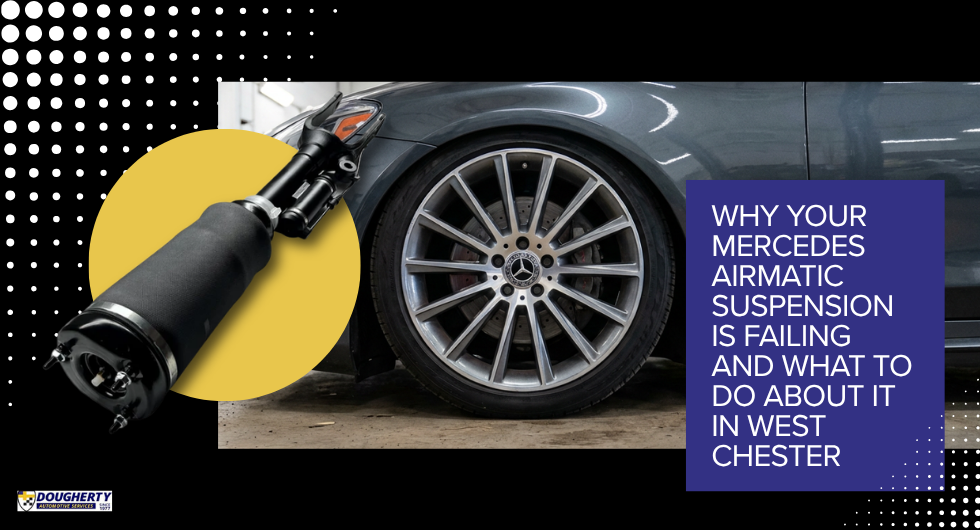
Why Your Mercedes AirMatic Suspension Is Failing and What To Do About It in West Chester
The AIRMATIC system is one of Mercedes-Benz‘s most sophisticated engineering achievements — a fully adaptive air suspension that reads road conditions in real time, adjusts ride height automatically, and delivers a level of comfort and handling precision that a conventional spring-and-shock setup simply can’t match. When it works, it’s invisible. When it fails, it announces itself loudly: a car that sits low to the ground overnight, a warning light that won’t clear, a ride quality that has turned from smooth to harsh, or corners where the car leans noticeably more than it used to. Dougherty Automotive Services in West Chester has been diagnosing and repairing European vehicles since 1977, and Mercedes AIRMATIC failures are among the most common suspension repairs their technicians handle. Here’s what goes wrong and how it’s properly fixed.
Air Spring Failure: The Most Common Entry Point
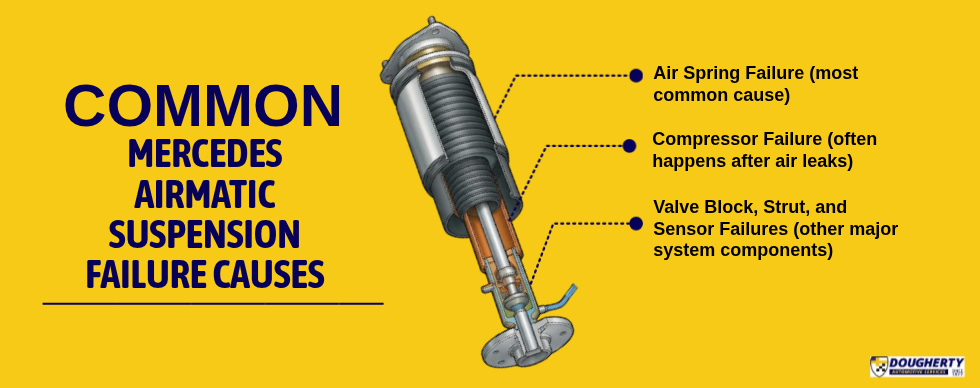
The air springs on a Mercedes AIRMATIC system replace conventional coil springs with rubber-and-fabric air bladders that inflate and deflate to maintain the correct ride height and compliance. These bladders degrade with age — the rubber dries out, micro-cracks form, and air leaks slowly out overnight. The result is a car that sits low on one corner or low across the entire rear after sitting in the driveway. Many drivers first notice the issue when the car feels oddly stiff after a cold night or when the AIRMATIC warning illuminates on the dashboard after the compressor has run excessively trying to maintain pressure. Air spring replacement is typically done in pairs — if one has failed, the other is usually near the same point in its life. Attempting to replace just one often leads to a return visit within months.
Compressor Failure: What Happens When the System Runs Dry
The AIRMATIC compressor pressurizes the system and manages ride height changes. When air springs leak, the compressor runs more frequently to compensate — and the increased duty cycle accelerates compressor wear. Eventually the compressor motor overheats, the piston rings or intake filter fail, and the compressor can no longer build adequate pressure. At this point the system drops to a low-ride failsafe position and the AIRMATIC warning stays on permanently. Dougherty’s technicians assess the compressor as part of every AIRMATIC diagnosis — sometimes the compressor can be rebuilt, but in most cases on a high-mileage Mercedes, replacement with a quality unit is the more reliable path.
Valve Block, Strut, and Sensor Failures
Beyond the air springs and compressor, the AIRMATIC system relies on a valve block that distributes air to each corner of the car, ride height sensors at each wheel, and strut assemblies that house the air spring and damper together. Valve block solenoid failures cause individual corners to stay stuck at the wrong height or fail to respond to adjustment commands. Ride height sensors — plastic units with a linkage arm connecting them to the suspension — crack or bind and feed incorrect data to the control module, causing erratic height adjustments. The control module itself can develop faults, though this is less common than hardware failures. An accurate AIRMATIC diagnosis maps out which component is actually failing rather than defaulting to the most expensive repair — something that requires factory-level diagnostic software and hands-on inspection.
Why Dougherty Automotive Is West Chester’s Mercedes Expert
Dougherty Automotive Services at 17 Hagerty Blvd has been a Bosch Authorized Service Center since 1977, earning a reputation for accurate diagnosis and for delivering repairs correctly the first time. Their 12,000-square-foot facility is equipped with state-of-the-art diagnostic equipment, and every scheduled repair comes with a free loaner car, so your schedule doesn’t have to stop because your Mercedes did. They service Mercedes, BMW, Audi, Porsche, Land Rover, Volvo, and more across West Chester, Malvern, Downingtown, and the broader Chester County area. For AIRMATIC diagnosis and repair, call (610) 692-6039.
FAQ
Why does my Mercedes sit low in the morning?
A Mercedes that sits low after overnight parking almost always indicates an air spring leak. The springs deflate slowly when the vehicle isn’t running, and the compressor re-inflates them when you start the car. If this happens consistently, the air springs should be inspected and likely replaced.
Can I drive a Mercedes with a failed AIRMATIC system?
You can drive carefully to a shop, but prolonged driving with AIRMATIC in failsafe mode can damage the struts, control arms, and compressor. The system is designed to protect itself by entering a low ride height position — that mode isn’t meant for extended driving.
How long do Mercedes AIRMATIC air springs last?
AIRMATIC air springs typically last between 80,000 and 120,000 miles, though age also matters — the rubber degrades from UV exposure and heat cycling regardless of mileage. Most failures occur on vehicles that are 10 or more years old.
Does Dougherty Automotive work on all Mercedes models?
Yes. Dougherty services the full Mercedes lineup, including C-Class, E-Class, S-Class, CLS, ML, GL, GLE, GLS, and AMG variants, handling everything from routine maintenance to complex suspension and electronics repairs.

Related Posts
