
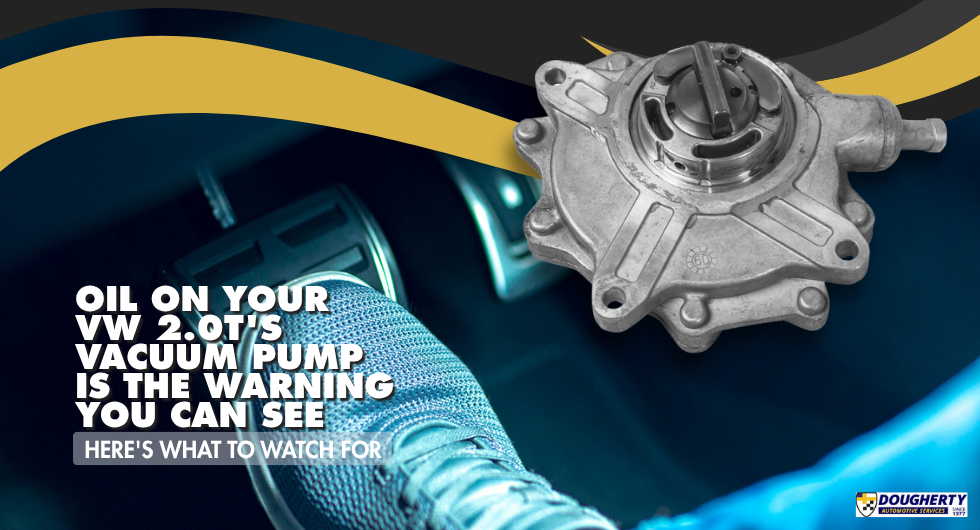
Oil on Your VW 2.0T’s Vacuum Pump Is the Warning You Can See. Here’s What to Watch For
On many Volkswagen 2.0T engines, brake assist comes from a small engine-driven pump. A VW vacuum pump can fail in two separate ways. Its seal can seep oil onto the housing, a fault you can spot at an oil change, or it can stop making vacuum, which turns the pedal hard. If you drive a GTI, Jetta, Tiguan or Passat around West Chester, have any seep looked at before the holiday runs up US-202 and onto the Turnpike.
Quick Summary: Key Takeaways
- Two different faults: a leaking seal can wet the pump housing while the pump still makes full vacuum, and a pump can lose vacuum with no oil in sight.
- A hard pedal is the warning that matters: a heavier push means the assist is fading or gone.
- Volkswagen documents the pump: its own paperwork confirms one on the 2008–2013 CCTA and CBFA 2.0L TSI, and a cam-driven one on certain 2016 1.8T and 2.0T engines.
- Trace the oil first: other 2.0T seals leak too.
A VW Vacuum Pump Feeds the Brake Booster on the 2.0T
The pump is there to keep the brake booster supplied. A non-turbo engine can draw that vacuum from its intake manifold, but a turbocharged engine spends much of its time with the intake side under boost, so a dedicated mechanical pump is the dependable source. That’s the job it does on these engines.
How it’s driven matters. In its 2015 recall of certain 2016 model-year 1.8T and 2.0T gas engines (NHTSA campaign 15V705), Volkswagen explained that one sintered cam lobe drives both the high-pressure fuel pump and the vacuum pump. Older cars have one too. A Volkswagen tech tip, revised in 2018, describes a brake vacuum pump on the 2008–2013 CCTA and CBFA engines in the Jetta, GTI, Golf, Passat, CC, Beetle and Tiguan.
Oil on the Pump Is the Fault You Can Catch Early
A seal leak and a loss of vacuum are separate problems, and the leak is the one you can see. The pump is sealed against engine oil, so a seal that has hardened over years of heat cycles can let a thin film creep out around the housing. Dust sticks to it. Give it a few months and the spot turns dark and gritty.
Trace it before you buy anything. Other 2.0T seals seep too, including the camshaft tensioner seals that give Audi’s 2.0T so much grief, and a drip seen from underneath can land inches from where it began. A burnt smell after a drive only tells you oil is reaching hot metal. It doesn’t name the seal.
A Hard Brake Pedal Means the Vacuum Supply Is Failing
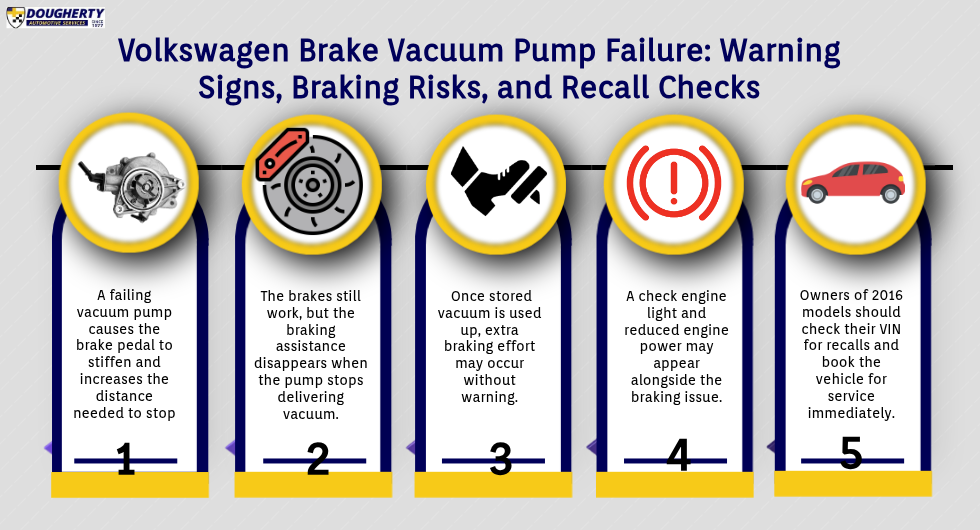
When the pump stops delivering vacuum, the pedal stiffens and the car needs more distance to stop. You still have brakes. What disappears is the assist, and it doesn’t always fade politely: in the 2016 recall, Volkswagen warned that once the stored vacuum is used up, the extra braking effort can arrive with no warning, alongside a check engine light and reduced engine power.
Stop driving it. If you own a 2016 model, run the VIN through a recall lookup as well, since that campaign’s fix was a software update. Then book it right away.
Holiday Miles on the Turnpike Are the Wrong Place to Find Out
Thanksgiving puts a crowd on the Turnpike. The PA Turnpike forecast about 3.4 million travelers between November 25 and November 30, 2025, with Wednesday, November 26 the busiest day at 705,000. From Hagerty Boulevard you reach it on Route 202 north to Valley Forge, or Route 100 north to Exit 312.
Holiday traffic means hard stops. The cheap moment to catch a seeping pump is the oil change before the trip. Every oil service at Dougherty includes a multi-point inspection, so ask the tech to look at the vacuum pump while the hood is up.
Fixing It Starts With Proving Which Part Is Leaking
The repair depends on what the pump still does. A pump that seeps but still holds full vacuum is a different job from one that has lost output, so the checks run in order: clean the area, run the engine, watch where fresh oil appears, then measure the vacuum. Each step rules something out.
The lines get checked too. On the CCTA and CBFA engines, Volkswagen notes that a clogged orifice in the vacuum tee off the pump can set EVAP or intake-runner codes, which can send a diagnosis the wrong way. A vacuum gauge settles that. Dougherty works with brand-specific diagnostic scanners and licensed software, so a stored code gets read in context.
Why West Chester VW Owners Bring It to Dougherty
Dougherty Automotive has been family-run in West Chester since 1977. As a Bosch Authorized Service Center, it works with the latest diagnostic equipment and specifications. Every customer gets an estimate first.
There’s also a free loaner car with scheduled repairs, and on this job it earns its keep. A car with a hard pedal shouldn’t be your commuter while parts arrive, and the shop sits just off South Matlack Street near the 202 Bypass, a short hop from Exton and Chadds Ford.
Frequently Asked Questions
Q: Can I drive my VW with a bad vacuum pump?
A: Not once the pedal goes hard. An oily pump with a normal-feeling pedal can be driven to the shop, but a stiff pedal means the assist is going, so park it and have it looked at before it goes anywhere else.
Q: What are the symptoms of a VW vacuum pump leak?
A: Look for a film of oily grime on the pump housing, sometimes with a burning smell after a drive. A pump that’s losing output shows up differently, as a stiff pedal that needs more force to stop the car.
Q: Which VW 2.0T engines use a brake vacuum pump?
A: Volkswagen’s documents confirm one on the 2008–2013 CCTA and CBFA 2.0L TSI and on certain 2016 1.8T and 2.0T gas engines, where a cam lobe drives it. For other years, the engine code tells a technician which pump your car has.
Book a VW Vacuum Pump Inspection in West Chester
Tell the service desk two things when you book on doughertyautomotive.com. Where did you see the oil, and how does the pedal feel? Then bring the car to 17 Hagerty Blvd, West Chester, PA 19382, or have it towed there if the pedal has already gone hard.
