
A drive belt is vital for maintaining the Land Rover’s performance. It powers the essential…

Land Rover Coolant Light On While You’re Stuck on Route 202? Don’t Ignore It
You’re crawling south on Route 202 toward West Chester in July heat, and the Land Rover flashes a coolant warning. That light is not a suggestion. On a Land Rover, a coolant alert usually means the system is losing fluid or running too hot, and summer traffic on 202 is exactly the load that brings it out.
The good news: caught early, it’s a manageable fix. Caught late, after you’ve driven it hot, it can cost you an engine. Here’s what the warning is telling you and what to do next.
Quick Summary: Key Takeaways
- The light means low or hot: A coolant warning signals either a low fluid level or an over-temperature condition – both need attention now.
- Land Rovers leak from known spots: Plastic crossover pipes, the thermostat housing, and hoses are common culprits.
- Summer traffic is the trigger: Stop-and-go heat on 202 pushes a marginal cooling system over the edge.
- Don’t drive it hot: If the temperature climbs, pull over – heat is what warps heads and blows gaskets.
- We diagnose the real cause: A pressure test finds the leak instead of guessing at parts.
The Coolant Light Means Low Level or High Temperature
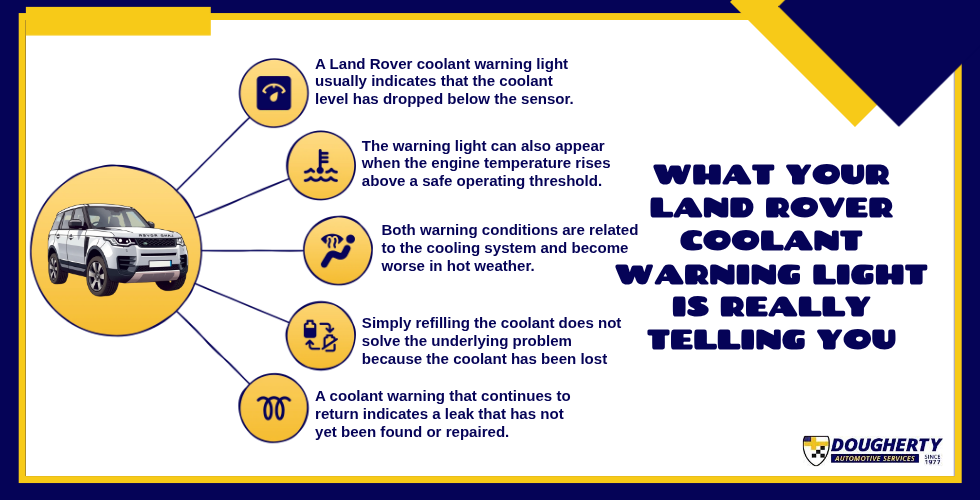
First, know what the car is telling you. A Land Rover coolant warning generally fires for one of two reasons: the coolant level has dropped below the sensor, or the engine temperature has climbed past a safe threshold. Both trace back to the cooling system, and both get worse in heat.
Don’t just top it off and drive on. The fluid went somewhere, and finding where is the whole point. A warning that keeps returning is a leak you haven’t found yet.
Land Rovers Leak From a Few Predictable Places
After years under these hoods, we know where they let go. The plastic coolant crossover pipe in the V-valley cracks and drips where you can’t see it, the thermostat housing splits, hoses swell and seep at the clamps, and an aging radiator can weep at its plastic end tanks until the level drops enough to trip the light.
Heat finds every one of these. A pipe that held through spring cracks the first week it’s 90 degrees, and you’re baking in traffic. That’s not bad luck – it’s the pattern.
Route 202 Traffic Is Where a Weak System Gives Up
Cooling systems fail under load, and summer gridlock is a brutal load. Sitting still in traffic on 202 with the AC on and no airflow through the grille, a Land Rover’s cooling system has to work its hardest exactly when the outside air is hottest, and that combination is what turns a slow seep into a warning light and then into steam. Highway speed hides it. The parking lot on 202 reveals it.
So the light coming on in traffic isn’t random. Far from it. It’s the system telling you it can’t keep up anymore.
What to Do the Moment the Light Comes On
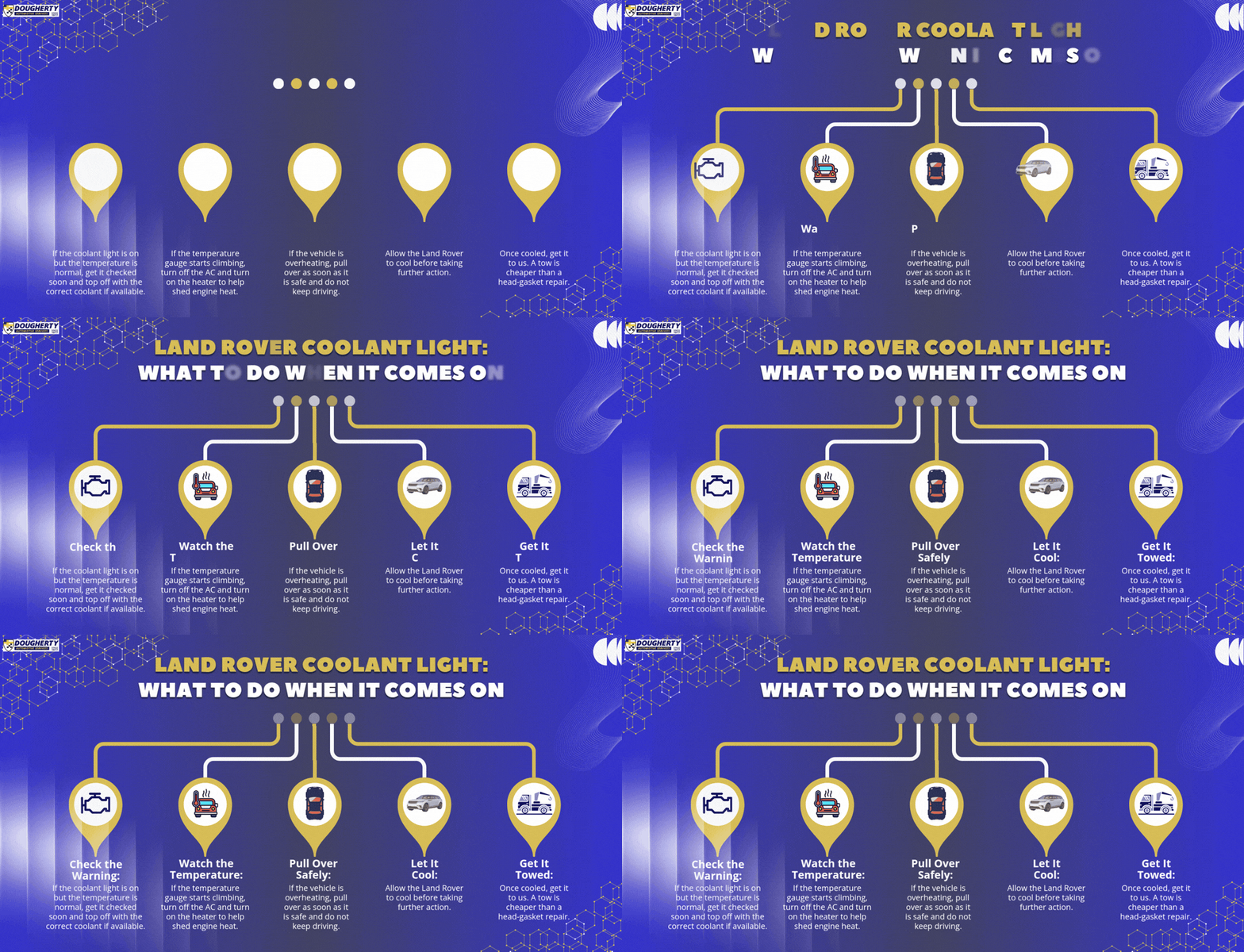
Your response here decides the repair bill. If the coolant light is on but the temperature is normal, get it checked soon and top off with the correct coolant if you have it. If the temperature gauge is also climbing, that’s different – turn off the AC, turn the heater on to shed engine heat, and pull over as soon as it’s safe.
Never keep driving a Land Rover that’s actually overheating. Let it cool, then get it to us. A tow is cheaper than a head gasket.
Why West Chester Land Rover Owners Trust Dougherty
We’ve been a Bosch Authorized Service Center in West Chester since 1977, and Land Rovers are regular work in our 12,000-square-foot shop on Hagerty Blvd. When your coolant light comes on, we pressure-test the system to find the actual leak, show you what we found, and fix it right – with a free loaner so your day doesn’t stop.
Summer is coolant season here. Nationally, AAA expected to rescue 7.7 million drivers over the summer of 2025, and cooling failures put a lot of them on the shoulder. Beat the light to the shop.
Frequently Asked Questions
Q: What does a coolant warning light mean on a Land Rover?
A: It usually means the coolant level has dropped too low or the engine is running too hot. Either way, it points to the cooling system, and on a Land Rover, the common causes are a cracked crossover pipe, a split thermostat housing, or a leaking hose or radiator. It should be checked promptly, especially in summer.
Q: Can I keep driving my Land Rover with the coolant light on?
A: If the temperature is still normal, drive straight to a shop and have it checked. If the temperature gauge is also climbing, stop as soon as it’s safe and shut the engine off. Driving an overheating Land Rover risks warping the head and blowing the gasket, which is a far bigger repair.
Q: Why does my Land Rover coolant light come on in traffic?
A: In stop-and-go traffic, there’s no airflow through the grille and the AC adds heat, so a cooling system that’s already marginal can’t keep up and either overheats or reveals a leak. That’s why the warning often appears on a hot day on Route 202 rather than at highway speed.
Q: How much does Land Rover cooling repair cost near West Chester?
A: A single hose or thermostat is on the lower end, while a crossover pipe or radiator costs more. The expensive scenario is engine damage from driving it hot, so the pressure test and early repair are what keep the bill down. We give you a firm price after diagnosis.
Get the Coolant Warning Diagnosed Right Away
Coolant light on after a hot run down 202? Bring it in and we’ll find the leak before it finds your engine.
Dougherty Automotive Services – 17 Hagerty Blvd, West Chester, PA 19382Hours: Monday-Friday, 8:00 AM – 5:00 PM
Website: doughertyautomotive.com

Related Posts